
Agentic AI in Retail: What the Technology Actually Does Now
From marketing to post-purchase, retailers are beginning to see real returns from agentic AI—but adoption, trust and data readiness remain uneven.
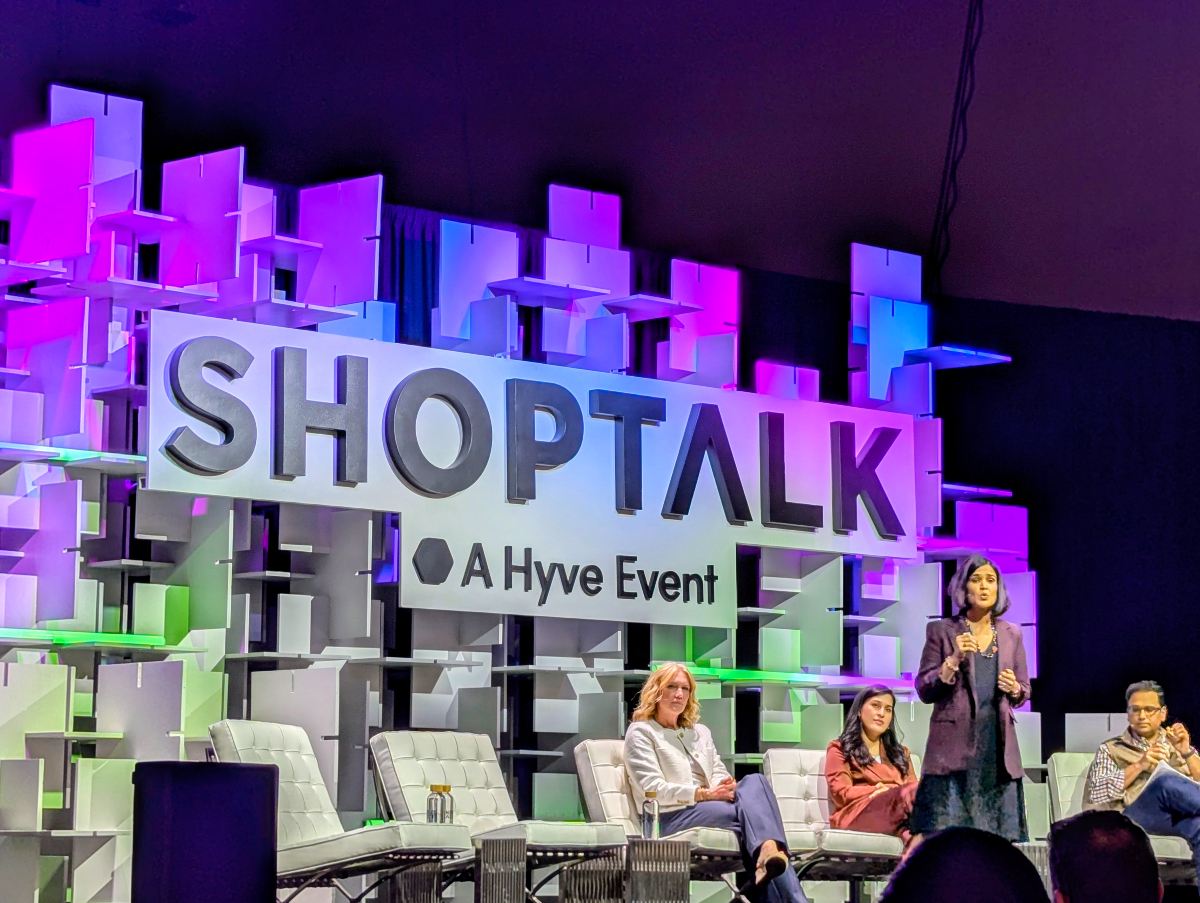
Shoptalk’s final day closed with a session that could have easily turned into a victory lap for AI. Instead, it offered something more useful: a nuanced look at what agentic AI is actually delivering for retailers today and where it still needs to prove itself.
Moderated by Bala Parameshwaran, partner at Bain & Company, the session opened with a telling data point: roughly 50% of consumers still don’t trust AI agents to handle end-to-end transactions on their behalf. That tension—rapid technological advancement paired with lagging consumer trust—set the tone for the conversation. Though the capability is here, adoption isn’t necessarily guaranteed.
Attentive: From Campaigns to Continuous Personalization
Keri McGhee, CMO of Attentive, argued that agentic AI in marketing is already moving from concept to revenue driver. Her assessment was blunt: most brands are still operating with outdated playbooks, sending uniform messages to broad audiences. That model is breaking down.
According to Attentive, more than 75% of consumers say they will leave a brand that fails to deliver personalized experiences. In response, the company’s AI agents operate continuously—resolving identity, determining channel preference, and interpreting purchase intent in real time—while marketers shift from campaign execution to orchestration.
The performance metrics reflect that shift. McGhee cited a 127% increase in purchases for Crate & Barrel after deploying AI-driven journeys, and an average 35% lift in revenue across Attentive’s AI suite, sustained over more than a year.
She offered a pragmatic tip for retailers: clean up your data, move beyond campaign-based thinking, and ensure that AI-generated interactions still reflect the brand’s voice.
Glance: Shopping Agents Move Closer to the Consumer
Glance is approaching agentic AI from a different angle by embedding it directly into the consumer interface rather than the brand’s owned channels.
The company positions itself as an “intelligent in-between,” learning user preferences and reducing friction in discovery and decision-making. Its distribution strategy is aggressive: projected reach of 50 million devices by the end of 2026 through partnerships with Samsung, Motorola, Verizon, and integrations across Android TV ecosystems, including DirecTV.
Glance is also opening its agent to brand integration, allowing retailers to feed product data directly into the system. COO Mansi Jain said the brands that fail to train these systems risk disappearing from emerging discovery pathways altogether.
In that context, early participation is less a competitive advantage than a defensive necessity.
Narvar: Rewriting the Post-Purchase Experience
Narvar CEO Anisa Kumar focused on a part of the customer journey that remains under-optimized: what happens after the transaction.
She illustrated the stakes with a striking example—a customer seeking $15,000 in damages after a product-related issue—underscoring how quickly post-purchase failures can escalate.
Narvar’s approach centers on building intelligence into that moment. Its neural network ingests purchase history, returns data, loyalty signals, warehouse inputs and fraud indicators to generate individualized lifetime value and risk scores. The result is a more adaptive, one-to-one post-purchase experience.
In a live demo, Kumar showed how an AI agent identified a fulfillment error, proactively replaced the item, followed up on fit, and resolved the issue through a digital wallet—without requiring customer escalation or losing the sale.
The impact is measurable. Kumar noted that up to 35% of return interactions can be converted into exchanges when handled this way, with Narvar assuming the associated risk.
The most effective retailers will anticipate and resolve problems before they boil over into full-blown crises, Kumar said.
Data First, Agents Second
Across the panel, the executives agreed that none of this works without high-quality data.
Whether it’s social signals, purchase behavior or post-purchase interactions, agentic systems are only as effective as the inputs they’re trained on. Misbah Uraizee, Co-Founder and CEO of Nectar Social, summarized it directly, noting that without strong data foundations, agents are flying blind.
That reality is creating a widening gap. Brands that invested early in data infrastructure are now able to operationalize agentic AI at scale. Those that did not are already playing catch-up.
The technology is no longer theoretical, and the revenue impact is increasingly measurable. But trust—and, for many brands, readiness—remains uneven.
Closing that gap is where the next phase of retail AI will be defined.
