
What Shein, Walmart, Authentic Brands, and Roberto Cavalli Tell Us About Retail Right Now
From Everlane’s sale to Shein to Walmart’s warning signs and the rise of brands as IP ecosystems, this week’s biggest fashion and retail stories exposed an industry confronting economic pressure, fragmented consumer trust, and a rapidly shifting definition of brand value.

This week’s biggest fashion stories all pointed to the same uncomfortable truth: brand equity means less when economic pressure starts rewriting the rules.
From a century-old denim label changing hands to one of the decade’s most jarring brand betrayals, the headlines coming out of fashion and retail this week exposed an industry grappling with a deeper identity crisis, one where heritage, authenticity, and consumer trust are increasingly colliding with financial reality.
Here’s what mattered, and what it signals for the future of brands.
Authentic Brands Group Adds Lee to Its Roster in a Deal Worth Up to $1 Billion
The week’s biggest deal came Wednesday, when Authentic Brands Group announced a definitive agreement to acquire Lee from Kontoor Brands in a transaction valued at up to $1 billion — $750 million upfront and an additional $250 million contingent on performance.
The numbers alone tell part of the story. Lee currently generates approximately $1.5 billion in annual retail-equivalent sales across 73 countries, with nearly 40 percent of that revenue coming from outside the U.S. and Canada. That’s a brand with genuine global reach and a 130-year legacy in denim and workwear. For Authentic, whose portfolio spans more than 50 brands and drives over $36 billion in annual systemwide retail sales worldwide, it’s precisely the kind of asset the company has built its model around.
“What makes Lee so compelling is its legacy,” said Jamie Salter, Founder and Executive Chairman of Authentic. “It’s one of the most important names in denim, with more than a century of heritage, consumer awareness and cultural relevance already built in.”
Upon closing, Authentic plans to convert Lee into a licensing model, leveraging its network of more than 1,700 brand partners across 150 countries. Talks are already underway with potential operators to expand the brand into content, experiences, and heritage-driven lifestyle categories. For Kontoor, the divestiture is a deliberate portfolio sharpening and frees up capital to concentrate on Wrangler and Helly Hansen, where the company sees its strongest structural growth opportunities.
The deal also landed amid a broader shift in how fashion brands are being valued and monetized. Increasingly, heritage labels are no longer viewed strictly as apparel businesses, but as expandable IP ecosystems capable of extending into hospitality, media, experiences, real estate, and licensing. The Lee acquisition follows last week’s Marc Jacobs transaction, reinforcing the growing perception that in today’s market, owning the story and cultural equity of a brand may matter more than owning the product itself.
The deal is subject to regulatory approval and expected to close in the second half of 2026. It also arrived alongside a leadership transition at Authentic, with Salter moving into the Executive Chairman role as former MGM Resorts CEO Matt Maddox steps in as CEO.

Kontoor Brands sold Lee Jeans to Authentic.
Roberto Cavalli Finds a New Partner in Marquee Brands
Earlier in the week, brand management firm Marquee Brands announced a definitive agreement to acquire a majority interest in Roberto Cavalli through a strategic partnership with DAMAC Group, the Dubai-based luxury real estate conglomerate that has owned the house since its emergence from insolvency.
Founded in Florence in 1970, Roberto Cavalli is a house defined by maximalism: animal prints, bold Italian craftsmanship, and unapologetic glamor. DAMAC has spent several years stabilizing the brand’s operations following its financial collapse. Now, with Marquee at the helm, the focus shifts from preservation to expansion.
“Roberto Cavalli stands as one of luxury’s defining Italian houses, with a bold creative identity and enduring brand ethos,” said Marquee CEO Heath Golden. “We see extraordinary potential to build on that foundation through thoughtful brand stewardship and strategic expansion.”
But the most revealing part of the deal may be what happens outside fashion entirely.
DAMAC will continue to oversee Roberto Cavalli-branded residences and hospitality projects, categories that remain fully under its ownership and operation. It’s another sign that luxury brands are increasingly evolving into multidimensional lifestyle properties rather than standalone fashion businesses. In many ways, the future of luxury appears less tied to seasonal collections and more tied to how effectively brands can monetize cultural identity across entirely different consumer touchpoints.
The deal is expected to close in Q2 2026 and brings Marquee’s total portfolio-wide retail sales to approximately $5 billion.
The Roberto Cavalli deal also arrives just one week after the Marc Jacobs transaction, reinforcing a broader shift underway across fashion and luxury: brands are increasingly being valued less as traditional apparel businesses and more as expandable intellectual property ecosystems.
Shein Buys Everlane, and the Internet Reacts
No story generated more heat this week than the confirmation, on Friday, that Shein has acquired Everlane from private equity firm L Catterton in a deal valued at approximately $100 million, essentially structured to absorb the brand’s $90 million in debt. Common shareholders will receive no payout.
The news had been circulating since the weekend, when Puck’s Lauren Sherman first reported that L Catterton’s board had approved the deal, setting off an immediate wave of backlash across fashion media and among Everlane’s loyal customer base. Friday’s official confirmation, which CEO Alfred Chang acknowledged in a statement to The New York Times, turned the rumble into a roar.
The cultural dissonance is difficult to overstate.
Everlane built its identity on “radical transparency,” publishing factory costs, championing ethical labor, and positioning itself as the antidote to the exact kind of ultra-fast-fashion machine that Shein has come to represent. At its peak, Everlane was valued at $250 million and was openly chasing $1 billion in annual revenue. That the company ultimately ends up absorbed by its ideological opposite feels symbolic of something larger happening across retail.
Chang told the Times that Everlane would “remain an independent brand” committed to sustainability and “exceptional quality,” and confirmed he would remain CEO. Representatives for Shein and L Catterton did not respond to the Times’ requests for comment.
The reaction from consumers and industry observers was swift and largely unforgiving.
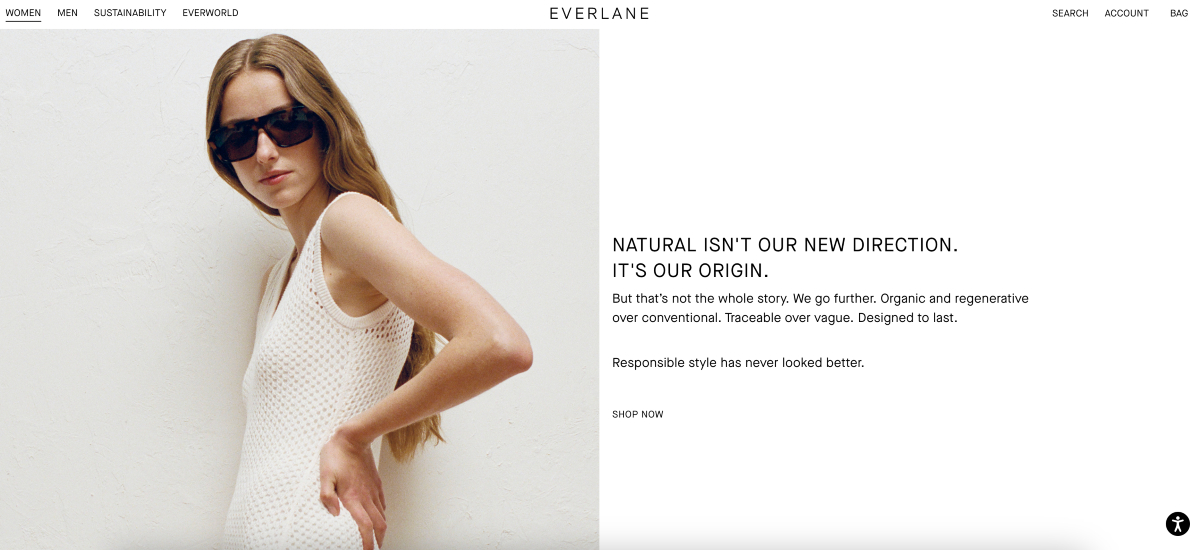
Shein, the ultra-fast-fashion juggernaut, bought Everlane, a brand once known for radical transparency.
“Everlane was built on this brand around sustainability and fewer, better things — and Shein often feels the opposite,” Katie Thomas of the Kearney Consumer Institute, a think tank, told NPR.
The harder question is what the acquisition actually accomplishes strategically. Does the Shein connection alienate Everlane’s core customer? Does it provide Shein with the legitimacy and brand credibility it has long struggled to earn? Or does Everlane simply become a faster-moving trend engine wrapped in cleaner branding language?
As Neil Saunders, Managing Director of GlobalData’s retail practice told the Times: “Everlane does become tarnished by being owned by Shein, and I don’t think it can be avoided.”
What’s increasingly clear is that the DTC era of values-driven storytelling is colliding with structural financial realities. Consumer affinity, however genuine, does not guarantee a viable business model on its own.
Everlane is hardly alone in that struggle. Brands that rose during the peak DTC era promising sustainability, transparency, and conscious consumption have spent the last several years colliding with a harsher operating environment defined by rising customer acquisition costs, slower growth, inventory pressure, and shifting consumer priorities. Allbirds — once held up as one of the defining success stories of purpose-driven consumer branding — recently abandoned the footwear business altogether and pivoted toward becoming an AI company after years of declining sales, store closures, layoffs, and a dramatic erosion in market value following its IPO peak.
Everlane’s outcome may be the starkest illustration yet of how difficult it has become to sustain idealism when growth slows, capital tightens, and scale remains elusive.
Walmart’s Strong Quarter Comes With a Warning Label
Walmart’s Q1 fiscal 2027 results, reported Wednesday, were impressive by almost every conventional measure: consolidated revenue of $177.8 billion, up 7.3 percent year-over-year; global eCommerce sales up 26 percent; Walmart+ membership revenue up 17.4 percent.
But beneath the strong earnings was a more sobering signal about the state of the American consumer.
Operating income growth of 5.0 percent lagged behind net sales growth, pressured by $175 million in higher-than-expected fuel costs across Walmart’s fulfillment network. Management warned that if elevated transportation costs persist, consumers should expect “somewhat higher retail price inflation” later this year.
That matters because the company’s own shopping behavior data already points to increasing financial strain. Walmart’s average ticket grew just 1.1 percent in Q1, down sharply from 2.8 percent a year ago, while transaction counts accelerated. Consumers are visiting more frequently but spending less each trip: a classic pressure signal.
CEO John Furner acknowledged during the earnings call that consumers, particularly in the U.S., remain highly value conscious. Walmart is currently running approximately 7,200 price rollbacks, up more than 20 percent year-over-year.
The tariff environment adds another layer of uncertainty. CFO John Rainey said Walmart is participating in the refund process on applicable tariffs but made clear that any recovered funds would be reinvested into pricing rather than margin expansion.
“The single best return on a dollar of capital right now is to invest in the customer and invest in price,” Rainey said.
Walmart’s results reinforce an uncomfortable reality for the broader retail industry: consumers haven’t stopped spending, but they have fundamentally changed how they spend. With frequency up and basket sizes down, the shift to value-seeking behavior seems like more than a temporary reaction to stubborn inflation.
Discovery Is Fragmenting Brand Power on Social
Rounding out the week, Dash Social released its 2026 Fashion Industry Social Media Benchmark Report, and the findings underscore how dramatically the mechanics of brand visibility are changing.
Discovery — content reaching consumers through algorithms, recommendations, and shares rather than follower-based distribution — has officially become the dominant growth engine across social platforms.
Instagram views surged 43 percent year-over-year, fueled largely by Reels. YouTube posted even more dramatic growth, with overall views up 68 percent and Shorts climbing 121 percent, while TikTok continued growing reach but saw engagement rates soften.
The implication is larger than platform strategy.
In a discovery-driven ecosystem, brands no longer fully control how consumers encounter them or what narrative sticks. Power is fragmenting as algorithms, creators, repost culture, and audience behavior increasingly shape perception alongside official brand messaging.
That shift carries profound implications for fashion and retail companies already navigating economic volatility and changing consumer expectations. The old model of carefully managed storytelling distributed through owned channels is starting to unravel. Visibility is increasingly decentralized, unpredictable, and shaped in real time by culture itself.
“Discovery is opening back up, and fashion brands have an opportunity to grow organically on social again,” says Dash Social EVP of Marketing Maggie Hickey.
But discovery cuts both ways. The same ecosystem that can rapidly elevate a brand can just as quickly expose contradictions, amplify backlash, or dilute carefully constructed positioning.
In today’s environment, owning a brand matters less than controlling how it’s understood.
Enjoyed this story? This article is just one of the ways Berns & Co. brings you closer to the ideas, people, and decisions moving our industry forward. Join our community of senior executives and industry insiders — subscribe to our weekly newsletter HERE.
About the Author:
Jessica Binns is Editorial Director at Berns & Co., where she leads editorial strategy and content programming, including the launch of a new thought leadership series profiling senior executives shaping the future of fashion, retail, and consumer goods. A journalist and editor with more than 15 years of experience covering apparel, footwear, retail, trade policy and tech, she is a contributing writer for Vogue Business and the former Managing Editor of Sourcing Journal. Her work has also appeared in WWD, Footwear News, and Retail Dive, and she has appeared on CNN This Morning with Audie Cornish to discuss the evolving fashion landscape.
